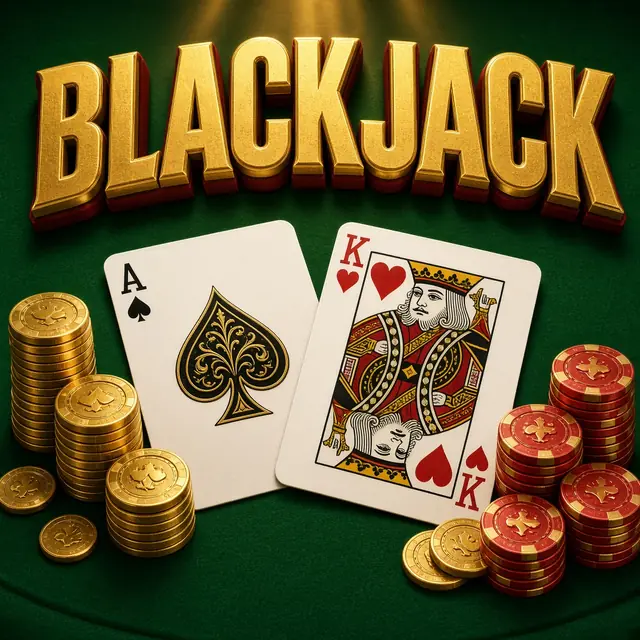
Banker
Even money, less a commission of normally five per cent. Wins slightly more often than player, and is the cheapest bet on the cloth even after the deduction.

Player, banker, tie
There are no decisions once the bet is down. The cards follow a printed drawing rule, the totals are counted in a slightly odd way, and the whole game comes down to which of two hands you backed.
Baccarat has a reputation for being complicated, and it is the simplest game in the pit to play. You put a bet on one of two hands. The cards come out according to a rule nobody at the table can change. The higher total wins. That is the entire game, and an evening of it requires no decisions after the first one.
What is genuinely worth learning is why that simplicity is priced the way it is: why the banker bet carries a commission, why the tie looks generous and is not, and why the side bets that studios keep adding are the most expensive chips on the cloth. The payouts quoted here are the standard ones; where a table varies, its own panel wins.
The game also attracts more superstition than any other table in the building, mostly because it hands you a scoreboard and nothing to do with your hands. The pages in this family keep repeating the same sentence for a reason: a shoe has no memory, and a drawn pattern is a record, not a forecast.
Two hands are dealt on the felt, called player and banker. Neither belongs to you; they are labels, and you may bet on either. Cards two to nine count at face value, aces count one, and tens and court cards count nothing at all. Totals are counted modulo ten, which is a formal way of saying only the last digit matters: a seven and a six make thirteen, which is a three. Nine is the best total available, and the hand closer to nine wins.
Because tens and court cards are worth zero, the game is effectively played with a compressed range of totals, and most hands are decided by a single point. That is why baccarat feels fast even when the shoe is slow, and why a scoreboard of results looks so much more meaningful than it is. Every hand is its own event, drawn from a freshly dealt position in a shoe nobody at the table controls.
The third-card rule is the part that sounds intimidating and matters least to a player. If either hand totals eight or nine on two cards, that is a natural and the hand ends. Otherwise a printed table decides whether player draws, and then whether banker draws, based on the totals already showing. You never choose. The dealer or the software simply follows it, which is why baccarat is the one table game where studying the rules does not improve your results — only your understanding of what you are watching.
Squeeze and no-commission variants exist in most lobbies. A squeeze table slows the reveal of the cards for atmosphere, which costs you nothing but time. A no-commission table drops the banker commission and pays a reduced amount on one particular winning banker total instead, which is a trade rather than a bonus. Both are listed alongside the rest of the pit on table games, and both state their terms in the help panel.
That last line catches people out more than anything else on this page. If the hands tie and you backed player or banker, your stake is returned — it is a push, not a loss and not a win. Only a bet placed on the tie itself is paid when a tie happens. Players who have watched a few hands and assume a tie means everybody loses are reading the table backwards.
Commission on a winning banker bet is normally five per cent, and online it is deducted automatically rather than tracked in a little box the way it is in a land-based pit. The result is that a winning banker bet returns slightly less than a winning player bet of the same size. That shortfall is not a penalty for choosing well; it exists precisely because banker is the stronger hand, and without it nobody would ever bet player.
Online tables repeat quickly, and most of them offer a repeat-bet button and a bet-history strip. The strip is fine. The button is the same hazard as everywhere else in the casino: it will re-stake last hand's bet while you are still thinking about last hand, and the money comes through UPI deposits all the same.
Even money, less a commission of normally five per cent. Wins slightly more often than player, and is the cheapest bet on the cloth even after the deduction.
Even money, no commission. Marginally worse than banker over a long shoe, and perfectly reasonable if you prefer the simpler payout.
Usually eight to one, sometimes nine. The payout looks like the prize of the evening and is far short of what the rarity of a tie is worth.
A side bet that the named hand's first two cards match in rank. Pays a large multiple and carries a much larger edge than the main bets.
Narrower or wider versions of the same idea. The narrower the condition, the bigger the headline price and the thinner the value.
Wagers on how many cards are dealt, or on the size of the winning margin. Studio inventions, priced as entertainment, and best understood as such.
The whole bet menu collapses into one sentence: back banker, back player if you dislike the commission, and leave everything else alone. Banker and player are the two cheapest bets available at any table game in the lobby. Every other box on the baccarat felt is substantially more expensive, and the gap is not small — it is the difference between a game you can play all evening on a modest budget and a game that quietly eats it.
The tie deserves its own paragraph because it is the trap that works. Ties genuinely do happen, often enough that you will see several in a shoe, and eight to one sounds like a fair price for something you watch arrive regularly. It is not, by a wide margin. A nine to one table is better than an eight to one table, and both are worse than not taking the bet.
Pair side bets are the other common leak, and they are attractive for the same reason: they resolve on the first two cards, so you find out quickly and the loss feels cheap. Repeated every hand, cheap becomes the main cost of the session. Keep them for the hands where you have decided in advance to spend a little on entertainment, or skip them entirely, which is what most steady players do.
The biggest one is reading the roads. Baccarat tables display elaborate scoreboards — a bead plate of results, a big road, and derived grids with names like big eye boy and cockroach pig — and they are drawn specifically to make streaks and alternations visible. None of them predicts anything. They are a rendering of what already happened, and the reason they exist is that a player with a pattern in front of them stays at the table longer than a player with a blank screen.
The second is betting the tie as a hedge. It is not a hedge; it is a third, separate, expensive bet that happens to pay when the other two push. Adding it to a banker bet does not protect the banker bet, it just increases the amount of money you have at risk per hand at a worse price. If you want less exposure, bet less.
The third is treating the commission as something to avoid. Players switch to player hands, or to no-commission tables, to dodge a five per cent deduction, and in doing so accept a slightly worse bet. The commission is the price of the better hand. Paying it is the normal, sensible outcome, and the no-commission tables that advertise its absence take payment in a reduced win on one specific total instead.
The fourth is the one baccarat shares with every other table: raising the stake to recover. The shoe is indifferent, the edge is constant, and a bigger bet on the same hand is simply a bigger bet. Because baccarat requires no decisions, there is nothing to occupy the part of your mind that wants to do something about a losing run, and the only available action is the stake. That is worth knowing before you sit, not after.
Software baccarat deals from a shuffled virtual shoe, settles instantly, and will deal the next hand as fast as you can click. Hands pass very quickly, which matters because the edge is charged per hand. Speed baccarat variants exist in both formats and compress the whole cycle into a few seconds, which is honest about what it is selling.
A live table puts a dealer and a physical shoe on camera, with a betting window on a clock. The pace is slower and the atmosphere is the product — the squeeze tables, where the cards are revealed slowly, exist entirely for that. None of it changes the drawing rule or the payouts, and all of it reduces how many hands an hour you are paying for, which is quietly in your favour.
Because baccarat needs no decisions, a poor connection costs you less here than at a blackjack seat. A stalled stream means you see the result late, not that the table decides something on your behalf. Even so, if the window closes while your screen is frozen you have missed a hand rather than lost one, and that is the better of the two outcomes. The lobby overview notes which rooms need bandwidth.
One practical note for anyone playing with an offer running. Baccarat is routinely excluded from wagering requirements or weighted at a small fraction, precisely because banker and player are so close to even. Confirm it on the offer card before you rely on it, using the method described on CroreBet bonuses, rather than discovering it in the cashier later.
Baccarat's main bets are among the cheapest things in an online casino, and its side bets are among the dearest. That spread is the practical lesson of the page. Banker is the best of them, player is close behind, and everything else on the cloth costs several times as much per rupee staked. A player who only ever backs banker or player is getting close to the best price the building offers; a player who sprinkles pairs and ties each hand is paying more than a slots session would cost.
Pace then decides the rest. Because the game needs nothing from you, it is easy to play two hundred hands without noticing, and a small edge charged two hundred times is a real amount of money. Autoplay and repeat-bet features make that worse. If you want baccarat to be the cheap game it can be, play it slowly, at a live table, on the main bets, at a stake you chose in advance.
Walking away is harder here than at games with decisions, because there is no natural pause. Build one: an amount, a clock time, and a rule that a winning run does not buy extra time. The warning signs are the same three as everywhere — a stake you did not plan, a bet placed to recover the last one, a second deposit in the same session — and the safer-play page exists for the evening when two of the three turn up together.
If the stillness of baccarat is not what you wanted, the pit has busier rooms. Blackjack gives you a decision on every hand. Roulette gives you a menu of prices. Casino poker gives you hand rankings and a bet to raise. Andar Bahar is the closest cousin to this game, with one middle card instead of two hands, and all of them sit on the same login from table games.
Pragmatic Play publish a free version of their table. It is loaded below, so you can watch the drawing rule play itself out a few times.
No. Player and banker are just the names of the two hands on the felt. You can bet on either one, and the casino pays out on whichever you backed. The labels are a historical leftover, and they confuse people every single night.
Marginally, yes, and that is why it carries a commission. Banker wins a little more often than player because it draws its third card with the benefit of seeing player's. After the commission it is still the cheaper of the two bets.
Because a tie happens rarely and pays far less than that rarity deserves. It carries by far the largest edge of the three main bets and it is the main reason an otherwise cheap game turns expensive.
No. The bead plate and the big road are history, drawn in a way that makes patterns look inevitable. A shoe does not owe you a run, and chasing one on any table game is the same mistake in a different costume.